




 Demo
Plinko Crypto Arcade by Top Providers (Chile)
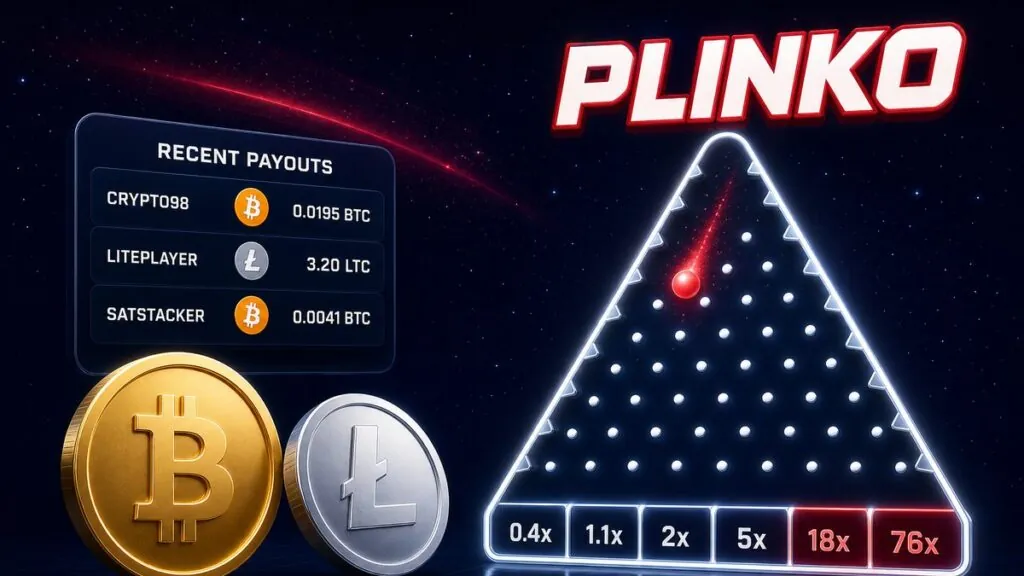
Plinko is an arcade-style crypto game built on one repeating action: a ball is dropped into a pyramid of pegs, deflected at every row, and lands in a multiplier pocket at the bottom. Releases from BGaming and Spribe have made it one of the most played provably fair titles in crypto casinos, with theoretical RTP running as high as 99.00%. Chilean players funding a balance in BTC, USDT or ETH get a format with a very thin house edge, settings they define themselves, and a demo that costs nothing to explore.
Key Plinko Game Facts for Chilean Players
| Parameter | Details |
| 💻 Top Providers | BGaming, Spribe, Stake Originals |
| 🎮 Game Type | Instant Win / Crypto Arcade Game |
| 🎨 Theme | Casual / Physics-based / Neon Pyramid |
| ⚙️ Mechanics | Gravity-driven sphere drop with peg deflections |
| 📊 RTP | Variable, up to 99.00% (BGaming: 99%, Spribe: 97%) |
| 💥 Volatility / Risk | Fully adjustable (Low, Normal, High risk profiles) |
| 📐 Grid Configuration | Adjustable row counts, typically 8 to 16 lines of pegs |
| 💸 Max Win Multiplier | Up to 1,000x or more on High Risk with 16 rows |
| 📥 Min Bet | 0.10 USDT (~CLP 95) or the equivalent in BTC, ETH, LTC |
| 📤 Max Bet | 100.00 USDT (~CLP 95,000) per drop, subject to platform limits |
| 🪄 Key Features | Customisable peg lines, instant manual drops, Turbo/Auto mode |
| 🕹️ Demo Mode | Available for free play in Chile |
| 📱 Mobile Play | Optimised for mobile screens and Web3 wallet browsers |
| ₿ Crypto Casino Play | Native support for Bitcoin, Ethereum, Tether and other major assets |
Why Plinko Stands Out in the Chilean Crypto Gambling Market
Chile sits in an unusual position. Land-based casinos are supervised by the Superintendencia de Casinos de Juego, but a dedicated framework for online casinos has been working its way through Congress for years without being finalised, leaving offshore sites operating in a grey zone that Chilean players navigate with their eyes open. Alongside that, Chile has one of Latin America’s more mature retail crypto scenes, with local exchanges and widespread stablecoin use for savings rather than speculation. The result is an audience that is comfortable with wallets and networks and correspondingly sceptical of unverifiable claims. Plinko fits that scepticism: the payout table is visible, the edge is quantifiable, and the volatility is chosen by the player instead of being fixed in the release.
Visual Design and Interface Overview
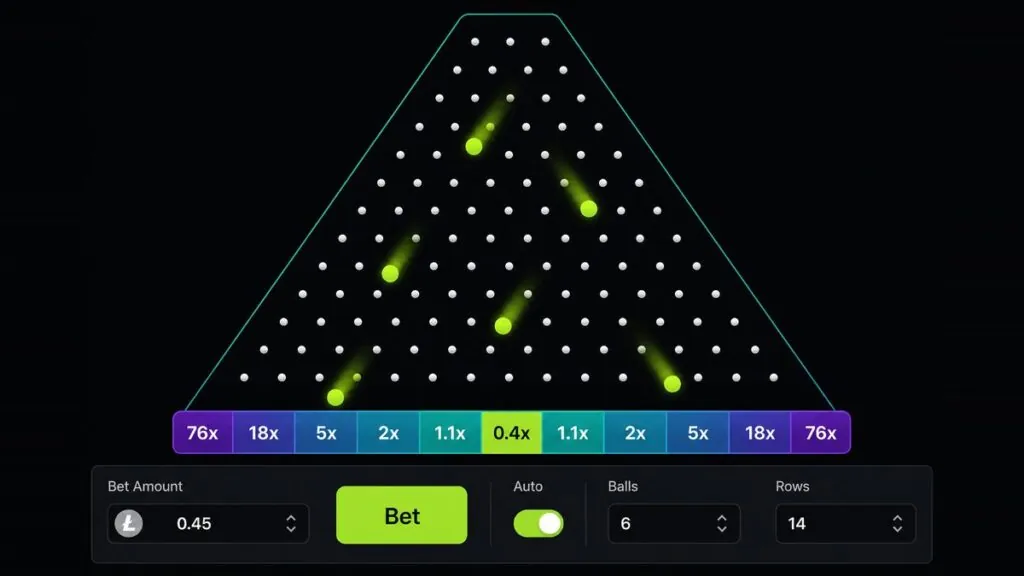
Plinko’s layout is almost schematic. A triangular grid of pegs fills the middle of the screen, with a row of coloured multiplier cells along the base. Its logic is symmetrical and instantly legible: the far-left and far-right cells hold the largest coefficients, the central cells return only a slice of the stake, and the gradient from red at the edges through amber to green in the middle communicates that before you read any numbers. There is no heavy 3D rendering and no intro sequence. For users in Chile this translates to speed and reliability — the board loads immediately on modest Android hardware, survives weak mobile data in regions outside the central corridor, and remains responsive over a VPN connection.
Game Mechanics: How to Play Plinko with Crypto
Four steps make up a round, and none of them are concealed.
1. Choose asset and stake. Select Bitcoin, Ethereum, USDT or another supported token and set an amount. Minimums around 0.10 USDT (~CLP 95) mean a substantial test session costs very little.
2. Configure the board. Set a risk profile and a row count. Between them these two values generate the entire multiplier table for the round, fixed before the ball moves rather than decided afterwards.
3. Drop the ball. One press releases a sphere from the top of the pyramid.
4. Read the outcome. Every peg contact nudges the ball one step left or right. It is rendered as a physics simulation, but the landing pocket is derived from the round’s random number generation and its cryptographic seed pair — the result was already determined when you pressed the button, and the animation simply shows it happening. Once the ball settles, your stake is multiplied by that pocket’s coefficient and credited on the spot.
The behaviour that separates Plinko from most casino formats is that a poor drop is rarely a complete loss. On Low and Normal risk the central pockets return part of the stake, typically between 0.5x and 1.1x, so a balance declines gradually instead of collapsing. That partial-return design is precisely what makes a theoretical return near 99% possible — and it is also the reason four-figure multipliers are as uncommon as they are.
Customizable Features and Strategic Betting Tools
Plinko exposes the settings most games keep hidden. Three of them define the session, and each one restructures the payout table rather than merely altering presentation.
Adjustable Risk Levels
Low, Normal and High are three different shapes for the same expected return. Low clusters the coefficients around 1x, producing frequent small returns, a slow-moving balance and a low ceiling. Normal widens the spread in both directions. High turns the middle of the board into a dependable loss — central pockets can fall to 0.2x or below — while stretching the outer pockets up toward 1,000x. The important point is that the risk selector never improves your expected value. It only decides whether you collect many modest results or wait a long time for a rare large one, and Chilean players working with a smaller balance will get far more playing time from Low or Normal.
Peg Rows Selection
The row count runs from 8 to 16. Each row you add inserts another layer of pegs and another left-or-right branch into the ball’s journey, while widening the board so extra pockets appear at both extremes. A longer path makes the edges statistically harder to reach, which is exactly why they can carry the highest coefficients. The 16-row High Risk board is the only configuration where 1,000x exists — and the money for it is taken out of the centre, where returns become noticeably worse. At 8 rows the distribution is compressed and much more forgiving.
Auto Play and Turbo Drop Mode
Auto mode releases a defined number of balls without further input, while Turbo compresses the drop animation so results land faster. Balls resolve independently and never obstruct each other, so several can be falling at once and the board becomes a steady cascade instead of a sequence of discrete rounds. For crypto players in Chile who want a meaningful sample rather than one slow drop at a time, this is the practical way to play — with the caveat that you should fix the ball count and stake before you start, since automation removes the natural moment where you would otherwise pause and reconsider.
RTP, Custom Volatility, and Provably Fair Logic
The headline figures are real: BGaming publishes 99.00% for its Plinko release, and Spribe’s sits close to 97%. RTP is a long-term theoretical figure and does not guarantee results in a single session. Those numbers are averages taken across millions of drops. Over a hundred drops — particularly on a 16-row High Risk board, which is engineered to bleed slowly and pay rarely — your observed return can land a long way from the published percentage in either direction.
The Provably Fair mechanism is what makes the transparency claim testable rather than promotional. Each round is built from three inputs: a server seed the platform commits to in hashed form beforehand, a client seed you control and can regenerate at will, and a nonce that increments with every drop. The ball’s path is a deterministic function of those values, meaning the result exists before the animation starts and cannot be adjusted in response to the size of your stake. After the round closes the server seed is revealed, and you can enter all three values into an independent verification calculator to reproduce the path. A match confirms no interference took place.
The limits of that guarantee should be stated clearly. Provably fair verifies individual rounds. It certifies nothing about licensing, financial stability or a platform’s willingness to pay withdrawals, and it is only meaningful if you actually run the check on a sample of rounds instead of assuming the feature works.
Plinko Free Demo Mode vs. Real-Money Crypto Betting
Demo mode runs the full game on virtual credits, and with Plinko it teaches something genuinely valuable: rhythm. Players in Chile can push several hundred free drops through a 16-row High Risk board and see for themselves how long the flat stretches between edge hits really are, and how quickly a balance thins out when nearly every result pays back a fraction. It is the same board and the same distribution as the funded version, at zero cost.
Real play requires a crypto balance, which introduces variables the game has no influence over. Deposit and withdrawal times and fees are set by the network you choose — Bitcoin, ERC-20 or TRC-20 — and by how busy it is, not by the game provider or by anything specific to Chile. Sending USDT over TRC-20 rather than ERC-20 is often the difference between a few pesos and several thousand in fees. On the on-ramp side, Chilean exchanges apply identity verification and CLP transfers settle on banking hours, so the slowest part of the process is usually fiat-to-crypto rather than anything on-chain.
Mobile Optimization and Web3 Browser Experience
Plinko was clearly designed portrait-first. The pyramid scales to a phone display without cropping, the multiplier row sits immediately above the thumb zone, and the risk and row controls are large enough to work one-handed on iOS and Android alike. The lightweight front end also means it functions properly inside wallet-embedded browsers such as MetaMask and Trust Wallet, which is how many crypto users in Chile reach casino platforms rather than through a standard mobile browser. There is nothing to install, and rotating the device or a brief signal drop will not break an auto-play run in progress.
Who is Plinko Best For?
Best for:
- Crypto casino users in Chile who want verifiable sessions and will run the hash check themselves.
- Tactical players who prefer defining their own volatility and risk-to-reward balance.
- Fans of retro arcade mechanics and fast, continuous gameplay loops.
- Players who value a format where a losing drop still returns part of the stake.
Not best for:
- Anyone looking for cinematic storylines, bonus wheels or free spin features.
- Players who prefer fixed, unchanging payline structures.
- Chilean players who lose patience during long sequences of low central multipliers.
Pros and Cons

- Theoretical return up to 99.00%, among the highest in any casino category.
- Complete control over risk profile (Low/Normal/High) and board size (8–16 rows).
- Verifiable round outcomes through public cryptographic hash checks.
- Simultaneous ball drops keep sessions fast and continuous.
- Minimal interface loads instantly on modest hardware and weak connections.

- No themed content, animated set pieces or Wild/Scatter mechanics.
- High-risk boards can drain a balance quickly during cold runs.
- 1,000x results are still limited by each platform’s maximum payout rules.
- Chile’s online casino framework remains unfinished, so crypto play happens on offshore sites without local consumer-protection recourse.
Final Thoughts on Plinko Crypto Game
Plinko suits a particular kind of player in Chile: someone who would rather examine a payout table than watch a bonus sequence, who values the ability to audit a result, and who wants a game that runs properly on an ordinary phone. The 99% figure is accurate but commonly misunderstood — it describes an average over an enormous number of drops, not a guarantee covering your session. Spend real time in the demo, watch how your intended risk-and-rows combination behaves over hundreds of drops, and set your limits before funding rather than in the middle of a losing run.
Plinko ball trajectories are governed entirely by cryptographic random number generation. No row setup, custom risk modification, or cryptocurrency token selection can outsmart or bypass the Provably Fair algorithm in Chile. Always play responsibly, treat blockchain gaming as entertainment only, and set strict daily loss limits.
Frequently Asked Questions
 What is the maximum win possible in crypto Plinko for players in Chile?
 Does changing the cryptocurrency affect the Plinko RTP or payouts?
Can I test the Plinko risk settings without making a deposit?
Is playing crypto Plinko legal in Chile?
How do I verify a Plinko round myself?